|
|
|
|
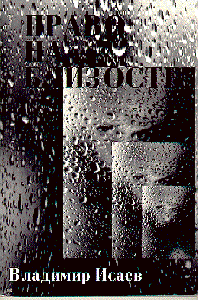
Vladimir Isaev
PRAVO NA BLIZOST
Povest i raskazi
(RIGHT TO INTIMACY, Novella and Short Stories)
in Russian; 1994; 252 pages; ISBN 0-916201-15-5; $5
The first book of an outstanding Russian writer whose
controversial prose could not be published in Russia. This book is excellent
and exciting reading material and may be used by Russian classes in Colleges
and Universities for study of modern Russian literature. The book includes the
following works: Pravo na blizost, Orator iz rimskogo lesa, Kashel, Ia escho
zdes, "Tselka", Zvonok mezhdu nog, Pismiatnik.
WORLD LITERATURE TODAY, USA, Winter, 1995
The first book by Vladimir Isaev, a young writer who lives in the Ukraine but writes in Russian, is likely to leave its readers unmoved. Titled Pravo na blizost (Right to Intimacy), the volume consists of six stories and one novel, written between 1990 and 1993, which are thematically united by the author's intention to explore unusual and extreme situations within the realm of everyday routine. Mostly, it is an absurdity of Soviet or post-Soviet reality which gives rise to abnormalities, whether situational or psychological, through there are also stories that reveal a universal rather than a particular approach, as in "Zvonok mezhdu nog" (The Bell Between the Legs) and "Tselka" (The Virgin).
Isaev's characters themselves are often perceived as odd, queer, or eccentric, and their behavior frequently exposes some patent signs of deviation. Thus the character from the story "Orator iz rimskogo lesa" (The Orator From the Roman Forest) in his business suit takes a train every day to a small forest station to deliver a lecture on some essential problems at the lonely glade. It is his way of expressing himself as an individual. Vladimir from "Zvonok mezhdu nog" is almost driven mad after a strange phone conversation in his hopeless endeavor to figure out his unknown respondent. His feverish fear seems unmotivated, but his gradual recollection of the harm done to other people may, to a certain extent, clear up the situation. Another erratic character, the protagonist of the "esoteric novel" "Pis'miatnik" (The Letterer), devotes all his time and energy to fishing out private letters from the mailboxes of strangers, until he finds himself drawn into a bizarre situation and has to undergo a phantasmagoric metamorphosis.
The physical exceptionality of Isaev's personages may be hyperbolized as well. The entire narrative of the story "Kashel" (The Cough) is triggered by the inappropriate reaction of several lodgers to the "irresistible, terrifying, volcanic cough" of their housemate. In the majority of stories, as well as in the novel, the first-person narrative, very suitable for showing up a particularly bizarre form of personality, is the narrative form of choice. However, this technique tends to be more effective when the "I" narrator is a weird individual himself.
As a rule, Isaev does not attempt to find psychological motivations for his characters' oddness, which commonly leaves the reader bewildered as to the message of the story; rather,he registers their peculiarity and exposes it to the reader. However, sometimes the author tries to deviate from the established pattern, as happens in one of his best stories, "Tselka." The plot here suggests a complicated example of the Electra complex, cultivated and cherished by a father who is unable to suppress his erotic attraction toward his own child. Masked by a special system of upbringing, that attraction does not reveal itself until the crucial event in Marianna's life, which allows her to realize the truth so thoroughly concealed in the depth of their hearts. The author's sketchy knowledge of psychology prevents him from accurately recounting the psychological nuances. Nevertheless, "Tselka" turns out to be a gripping story, providing the writer with matchless material revolving around the challenging theme of unconsciously desired incest.
Another arresting work is the hyperbolic story "Ia eshche zdes" (I Am Still Here), in which the author explores the quite popular theme of inevitable loneliness. Haunted by complexes and obsessions, the protagonist dares not believe in the possibility of meeting a kindred soul. His morbid suspicion and distrust drive his unexpected companion to disappear from his life, and probably from life itself. The open, slightly ambiguous ending of the story invites various interpretations, which emphasize the work's metaphorical meaning.
The title story unfortunately lacks psychological and situational cogency. Centered on an episode of gang rape, the narrative attempts to reproduce the described events from the perspective of both the victim and her admirer.
Finding himself the witness of a heinous crime, the main character Gleb experiences diverse emotions ranging from paralyzing fear and powerless rage to an unexpected and poorly motivated affection for the rapists. In all likelihood, it is the sincerity of his "altruistic" love for the violators that forces him to join them in the act of violence. This climax is presented by the author (who reveals here an amazing ignorance of the fundamentals of psychology, female psychology in particular) as a sort of epiphany for Gleb and as a lucid interval for the brutally deflowered girl. Undoubtedly the whole story presents a fruitful case for feminist criticism to investigate the issue of explicit male chauvinism in post-Soviet writing, irrespective of its language.
The format of the present review does permit us to dwell on some other peculiarities of Isaev's narrative technique and individual style, although his language deserves I at least a very brief comment. There is no mistaking the author's considerable attempt to utilize various tropes and stylistic devices in order to make his language expressive. By and large it works; nevertheless, there are abundant passages in the book, primarily those of a descriptive nature, which are too wordy, nebulous, or flaccid due to an overabundance of poetic figures, both semantic and syntactic. Its shortcomings notwithstanding, Isaev's collection of stories may be of interest to the general public.
The young writer has created an easygoing and often quite exciting book, exploring eroticism and other marketable themes, that stands out in the recent flood of Russian fiction.
Tatiana Nazarenko
University of Alberta

